Canstar Resources Intersects 15.6 Metres of Massive Sulphide Grading 2.3% CuEq at Mary March, Including 9.75 Metres at 3.3% CuEq
All Four Phase 1 Holes Intersect MineralizationTORONTO, ON, Aug 27, 2026 - (ACN Newswire) - Canstar Resources Inc. (TSXV: ROX) (OTCID: CSRNF) ("Canstar" or the "Company") today reported results from the first phase of its 2026 drill program, including the widest massive sulphide intercept in the dri
All Four Phase 1 Holes Intersect Mineralization
TORONTO, ON, Aug 27, 2026 - (ACN Newswire) - Canstar Resources Inc. (TSXV: ROX) (OTCID: CSRNF) ("Canstar" or the "Company") today reported results from the first phase of its 2026 drill program, including the widest massive sulphide intercept in the drilling record of its Mary March Project in the Buchans district of central Newfoundland: 15.6 metres ("m") grading 2.3% copper equivalent ("CuEq")¹ starting at a downhole depth of 467.4 m in drill hole MM-26-42, including 9.75 m at 3.3% CuEq¹. The reported interval is a downhole length through fault-bounded massive sulphide (rock logged at greater than 50% sulphide minerals) hosted by a rhyolite flow-dome, designated the Fleetway Rhyolite; its full width was not intersected. The mineralization remains open along strike and at depth.
All four holes of the 2026 summer drill program intersected visually logged mineralization typical of a volcanogenic massive sulphide ("VMS") system, close to the depths anticipated by the Company's geological model, which will guide the placement of future drill holes. Drill holes MM-26-41, MM-26-43 and MM-26-44 were the first to pierce the full thickness of the Fleetway Rhyolite, with apparent thickness ranging from 298 to 320 m. Across the program, massive sulphide was intersected in two holes (the second visually logged, with assays pending²), and most of the host unit remains untested.
As announced on July 21, 2026, earn-in partner VMS Mining Corporation ("VMSC") invested an additional $2.0 million ahead of schedule, bringing total funding to $4.0 million to date, including $3.5 million in 2026. VMSC's advance funds a planned fall drill campaign, which remains subject to drill-rig availability and other operational considerations. The program follows more than a year of systematic targeting work led by Dr. Harold Gibson, Vice President, Exploration of VMSC, with input from Dr. Rodney Allen, Volcanic Resources AB and former Chief Geologist of Boliden, on the re-logging of historic core and comparisons to the Buchans host rocks.
Highlights
Widest massive sulphide intercept in the Project's drilling record: Drill hole MM-26-42 intersected 15.6 m of massive sulphide grading 2.3% CuEq¹ (0.73% copper, 0.73% lead, 2.10% zinc, 0.71 grams per tonne ("g/t") gold and 19.0 g/t silver). The interval, a core length rather than true thickness, occurs 60 m below the upper contact of the rhyolite and lies approximately 100 m along strike from the previously reported 1999 discovery intercept⁴.
Including 9.75 m at 3.3% CuEq¹ (1.13% copper, 1.14% lead, 3.27% zinc, 0.89 g/t gold and 25.5 g/t silver), which includes 5.0 m at 3.9% CuEq¹ (1.71% copper, 1.11% lead, 3.02% zinc, 0.94 g/t gold and 32.6 g/t silver).
The hole was stopped by unstable ground conditions associated with a fault zone at approximately 576 m, before reaching the lower rhyolite contact, which remains untested at this location. Assays are pending for a discrete 1 m visually logged massive sulphide interval 19 m below the main assayed interval².
Massive sulphide intersected in a second hole: Drill hole MM-26-44 intersected two narrow intervals of visually logged massive sulphide, with zinc and copper sulphide minerals, at the upper rhyolite contact (330.7—331.9 m and 332.2—333.8 m; approximately 2.8 m combined; assays pending²). The hole also intersected strongly altered, pyritic mafic breccias at the lower rhyolite contact (632.5 m). VMS systems may form more than one massive sulphide lens within a host rhyolite.
Interpreted potential VMS feeder zone identified: Drill hole MM-26-41 encountered copper- and zinc-bearing stringer and disseminated mineralization in multiple intervals totalling approximately 271 m of altered rhyolite, strongest over the upper 118 m, interpreted as a potential VMS feeder zone, the conduit beneath a massive sulphide lens (reported July 8, 2026)³; assays pending. Below the lower rhyolite contact at 710.6 m, mafic breccias carry an 8 m interval of stringer mineralization containing chalcopyrite and sphalerite (assays pending).
Step-out hole extends mineralized area: Drill hole MM-26-43 intersected the upper rhyolite contact at 478 m, approximately 130 m from hole MM-26-42 (100 m deeper and 75 m to the southwest), extending the altered rhyolite to the southwest; the faulted contact lies within a 17 m interval of visually logged moderate mineralization, and altered rhyolite continues to 676 m. Assays pending².
Further drill results and drilling anticipated: Assay results are expected through September. Borehole electromagnetic ("BHEM") surveying of all four PVC-cased holes, which can detect conductive massive sulphide beyond the drill holes, is expected to begin mid-September. Planning is underway to secure a drill rig for a fall program targeted to begin in October, pending drill-rig availability and other operational considerations.
Mary March project ownership consolidated: Glencore's legacy joint-venture interest in Mary March converted to a 2% net smelter returns royalty, consolidating Project ownership under Canstar and VMSC.
Juan Carlos Giron Jr., President & CEO of Canstar, commented: "We are encouraged to have intersected the widest massive sulphide interval in Mary March's drilling record, in the first holes drilled here since 2019, and to have found it where our geological model predicted it. Buchans is a historically productive VMS district: the camp, just 20 km from us, produced some of the highest-grade VMS ore mined in North American history⁵, and Mary March has comparable host rocks. VMSC's accelerated $2.0 million investment supports the next phase of work, and the planned fall campaign will continue testing the system."
Bob Patey, P.Geo., Vice President, Exploration, commented: "This drill program began testing the rhyolite systematically, including, for the first time, its far southeastern margin and its base. This second notable massive sulphide intercept at Mary March may indicate a significant mineralized system, subject to further drilling and assay confirmation. VMS systems can form multiple massive sulphide lenses stacked through the target rhyolite interval, and we believe that internal contacts within the Fleetway Rhyolite and its lower contact warrant further testing, guided by our systematic targeting approach."
Assay Results and Interpretation
VMS deposits form from sea-floor hydrothermal systems and can occur within a host rhyolite and at its margins, commonly as more than one lens. The massive sulphide mineralization in MM-26-42 is bounded by faults, and the Project's historic discovery intercept, known as the Mary March intercept (9.63 m grading 10.1% zinc, 1.8% lead, 0.64% copper, 122 g/t silver and 4.2 g/t gold, 1999)⁴, approximately 100 m along strike to the northeast, is likewise fault-bounded. These intercepts may not reflect the complete width of the original massive sulphide lens or lenses. Because the Mary March sequence has been folded and faulted, the position of these intercepts within the original mineralizing system cannot yet be determined, and no inference is drawn from the differing metal contents of the two intercepts.
Drill holes MM-26-41, MM-26-43 and MM-26-44 each pierced the entire rhyolite package, which measures approximately 298 to 320 m in apparent thickness where pierced, including approximately 302 m in MM-26-44, updating the approximately 250 m previously reported³. Most of the Fleetway Rhyolite, including the lower contact below MM-26-42, remains prospective and has not yet been drill-tested. Based on limited drilling so far, the mineralized system is open along strike and at depth and requires further drilling to assess its extent.
Reported intervals are downhole lengths. The true thickness of the mineralized material that was intersected is interpreted to be less than the downhole lengths of the intervals, and the full width of the original fault-bounded massive sulphide has not been determined; both will require further drilling.¹ The Company is not estimating the dimensions of any mineralized body based on current drill results.
Table 1: MM-26-42 composite assay results
| Interval | From (m) | To (m) | Length (m) | Cu % | Pb % | Zn % | Au g/t | Ag g/t | CuEq %¹ |
| Massive sulphide interval | 467.4 | 483.0 | 15.6 | 0.73 | 0.73 | 2.10 | 0.71 | 19.0 | 2.3 |
| including | 473.25 | 483.0 | 9.75 | 1.13 | 1.14 | 3.27 | 0.89 | 25.5 | 3.3 |
| including | 476.0 | 481.0 | 5.0 | 1.71 | 1.11 | 3.02 | 0.94 | 32.6 | 3.9 |
Table 2: MM-26-42 sample-by-sample assay results
| Sample | From (m) | To (m) | Length (m) | Cu % | Pb % | Zn % | Au g/t | Ag g/t |
| 378841 | 467.4 | 469.0 | 1.6 | 0.07 | 0.09 | 0.33 | 0.34 | 9.7 |
| 378842 | 469.0 | 470.0 | 1.0 | 0.10 | 0.01 | 0.19 | 0.34 | 6.1 |
| 378843 | 470.0 | 471.0 | 1.0 | 0.07 | 0.01 | 0.09 | 0.42 | 6.6 |
| 378827 | 471.0 | 472.0 | 1.0 | 0.02 | 0.03 | 0.05 | 0.55 | 11.1 |
| 378828 | 472.0 | 473.25 | 1.25 | 0.03 | 0.03 | 0.08 | 0.50 | 6.5 |
| 378829 | 473.25 | 474.0 | 0.75 | 0.39 | 1.04 | 4.63 | 0.71 | 11.3 |
| 378830 | 474.0 | 475.0 | 1.0 | 0.98 | 1.59 | 4.40 | 0.98 | 21.2 |
| 378831 | 475.0 | 476.0 | 1.0 | 0.66 | 2.53 | 6.53 | 1.61 | 34.3 |
| 378832 | 476.0 | 477.0 | 1.0 | 1.66 | 1.40 | 4.41 | 1.13 | 36.7 |
| 378833 | 477.0 | 478.0 | 1.0 | 2.03 | 1.85 | 3.76 | 1.19 | 47.6 |
| 378834 | 478.0 | 479.0 | 1.0 | 2.74 | 0.34 | 0.69 | 0.76 | 34.3 |
| 378835 | 479.0 | 481.0 | 2.0 | 1.05 | 0.97 | 3.13 | 0.82 | 22.2 |
| 378836 | 481.0 | 482.0 | 1.0 | 0.33 | 0.50 | 1.56 | 0.43 | 13.1 |
| 378837 | 482.0 | 483.0 | 1.0 | 0.18 | 0.19 | 0.78 | 0.37 | 9.0 |
Table 3: Visually logged massive sulphide, assays pending
| Hole | From (m) | To (m) | Length (m) | Status |
| MM-26-42 | 501.8 | 502.8 | 1.0 | Visually logged massive sulphide interval, with assays pending² |
| MM-26-44 | 330.7 | 331.9 | 1.2 | Visually logged massive sulphide interval, with assays pending² |
| MM-26-44 | 332.2 | 333.8 | 1.6 | Visually logged massive sulphide interval, with assays pending² |
Quality Assurance / Quality Control ("QA/QC")
Samples of sawn half core were prepared at the Canstar core shed facility in Millertown, Newfoundland and Labrador, packed in bags secured with heavy-duty, tamper-evident plastic seals, and shipped by commercial carrier to ALS in Moncton, New Brunswick. ALS Canada Ltd. is independent of Canstar and is accredited to ISO/IEC 17025:2017 and certified to ISO 9001:2015. Certified reference materials, consisting of four reference standards and two blanks, were inserted within every 100 samples. Samples were analyzed using a four-acid digestion package (ME-4ACD81), and samples assaying over 10,000 parts per million ("ppm") silver, copper, lead or zinc were re-run using an over-limit method for that element (Ag-OG62, Cu-OG62, Pb-OG62, Zn-OG62). Gold was analyzed using a 30 g fire assay with an atomic absorption finish (Au-AA25). The Company's Qualified Person ("QP") compared the analytical results of the reference materials to the accepted values, confirming acceptable accuracy of the analysis.
Table 4: Drill hole collar details
| Hole ID | Easting | Northing | Elevation (m) | Azimuth | Dip | Depth (m) |
| MM-26-41 | 534419 | 5408974 | 188 | 145.52 | -47.9 | 757.0 |
| MM-26-42 | 534326 | 5408892 | 191 | 140.5 | -68.31 | 576.0 |
| MM-26-43 | 534283 | 5408843 | 193 | 136.58 | -57.75 | 745.0 |
| MM-26-44 | 534326 | 5408892 | 191 | 133.04 | -58.98 | 678.0 |
Collar coordinates are NAD27, UTM Zone 21N; negative dips denote downward inclination. MM-26-42 and MM-26-44 were drilled from the same pad. Program total: 2,756 m in four holes.
Beyond the Priority Target
The Fleetway Rhyolite is the Company's priority target at Mary March, which has multiple prospective areas; government research describes the Mary March alteration system as among the most significant reported in the region⁶. Approximately 1.8 kilometres northeast of the current drill holes, 2019 trenching discovered, in bedrock, massive sulphide clasts in a debris-flow unit with grab samples returning up to 5.7% copper⁷. Transported sulphide clasts of this kind also formed part of the historically mined Buchans ores⁵. The source of the sulphide clasts has not been located. The Nancy April zone hosts footwall zinc mineralization in historic drill hole MM-294-03, which intersected 20.6 m grading 0.13% Cu, 1.08% Pb, 3.02% Zn and 3.43 g/t Ag⁴. A discrete chargeability anomaly located more than 600 m to the northwest of the Nancy April zone, as observed within the Company's recent induced polarization ("IP") survey, has yet to be drill-tested.
Ownership Consolidated: Glencore Legacy Interest Converted to Royalty
Canstar also announces that the legacy joint-venture interest of Glencore Canada Corporation ("Glencore") in a portion of the Mary March property has been converted into a 2% net smelter returns royalty. The conversion consolidates the Project's ownership structure under Canstar and its earn-in partner VMSC, resolving a legacy arrangement that predated the Company's current programs.
Next Steps
- Assay results for drill holes MM-26-41, MM-26-43 and MM-26-44, along with the remaining MM-26-42 samples, are expected through September.
- BHEM surveys of all four PVC-cased holes are expected to begin mid-September and will test for off-hole conductors to refine targets for the fall campaign.
- The fall drill campaign under the joint venture with VMSC is currently being planned; planning is underway to secure a drill rig, with drilling targeted to begin in October, subject to drill-rig availability and other operational considerations.
The Company will provide further updates on its 2026 drilling campaign as it progresses.
Qualified Person
Bob Patey, B.Sc. (Hons.), P.Geo., Vice President, Exploration of Canstar and a Qualified Person as defined in National Instrument 43-101 - Standards of Disclosure for Mineral Projects ("NI 43-101"), has reviewed and approved the scientific and technical information disclosed in this news release, and has verified that the 15.6 m interval in drill hole MM-26-42 is the widest massive sulphide intercept in the Project's drilling record.
Figures
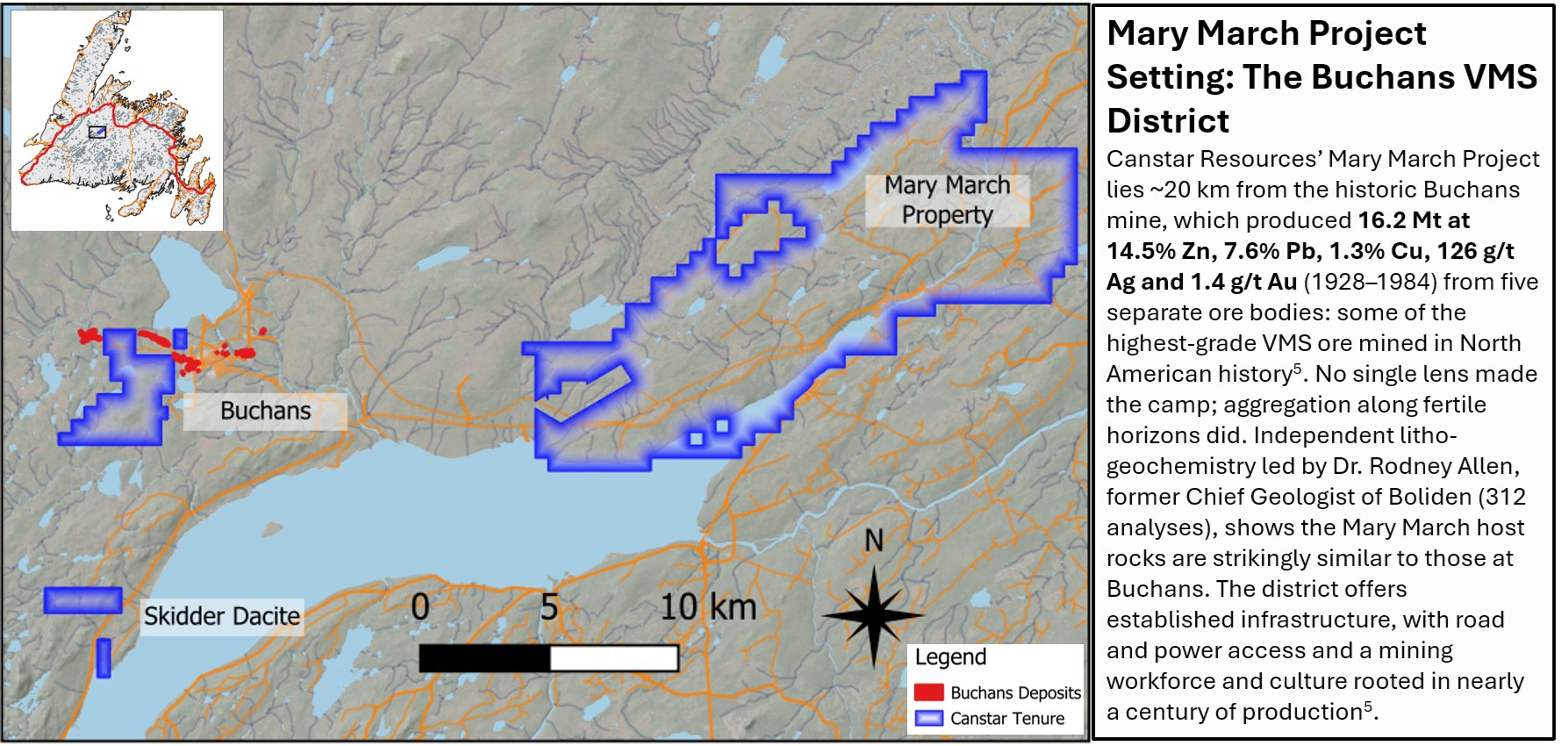
Figure 1: Mary March Project in the Buchans VMS district, approximately 20 km from the historic Buchans mine.
To view an enhanced version of this graphic, please visit:
https://images.newsfilecorp.com/files/1665/311773_b8624fd3d470e915_001full.jpg
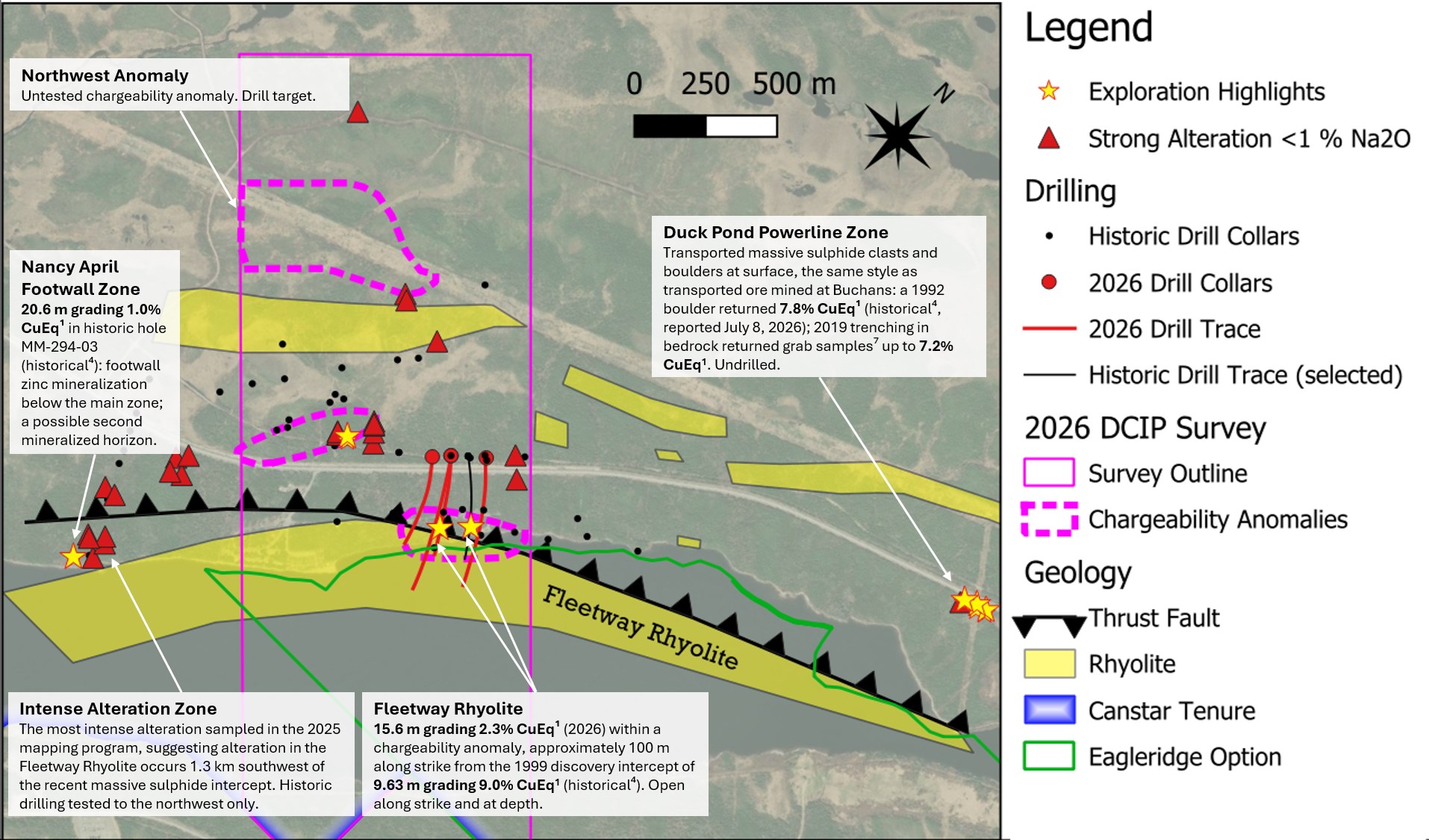
Figure 2: Mary March prospectivity map. Drill traces and the rhyolite outline are projected to surface: the 2026 holes intersected the rhyolite's southeast margin at depth, and that contact is projected to surface here. Chargeability anomalies are geophysical model shapes, not mineralization outlines. Grades are shown where assays have been received.
To view an enhanced version of this graphic, please visit:
https://images.newsfilecorp.com/files/1665/311773_b8624fd3d470e915_002full.jpg
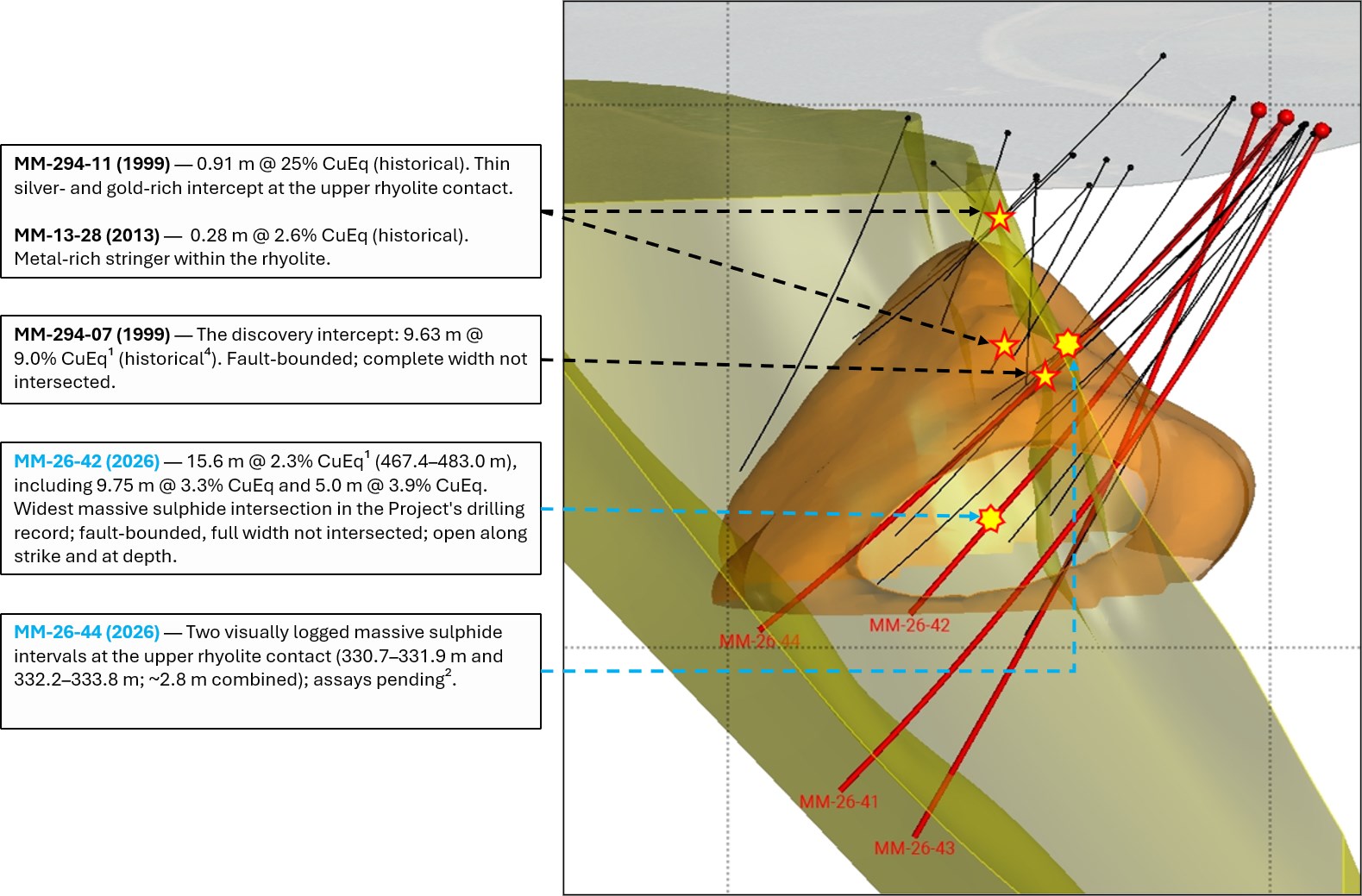
Figure 3: Three-dimensional geological model of the Mary March area, viewed toward the southwest. Drill holes are shown in their true relative positions; no scale applies to this oblique view. Rhyolite host (yellow); direct current induced polarization ("DCIP") chargeability model surface (orange; a geophysical model shape, not a mineralization outline); historic drill holes (black); 2026 drill holes (red traces, labelled in blue); stars mark massive sulphide intersections. Intervals are downhole lengths; historical intercepts per note 4.
To view an enhanced version of this graphic, please visit:
https://images.newsfilecorp.com/files/1665/311773_b8624fd3d470e915_003full.jpg
Copper-equivalent grades shown in the figures are calculated using the formula, metal prices and assumptions described in the notes to this release; historical intercepts are downhole lengths from records predating NI 43-101; visually logged intervals are pending assay and no grade, width or continuity is reported or implied.¹, ², ⁴
Drill-Core Photographs
Massive sulphide of the type intersected at Mary March is dense, uniformly sulphidic rock, dominated by pyrite and generally grey to brassy in appearance. The copper, zinc, lead, gold and silver values reported in Table 1, as determined by assays, are carried in chalcopyrite, sphalerite and galena distributed throughout the sulphide mass. The photographs below are provided to show the character of the core and are not representative of grade, width, continuity or abundance of mineralization.
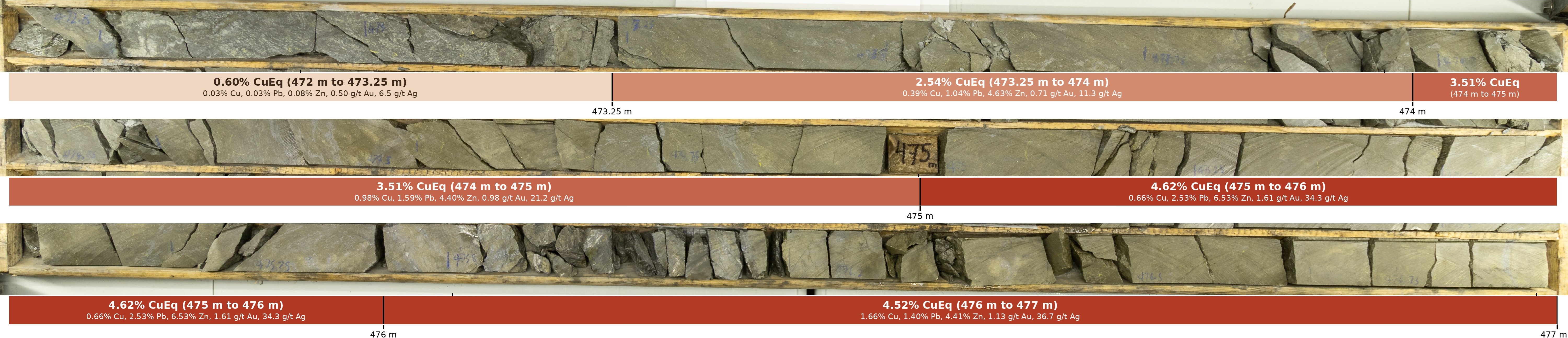
Photo 1 — Core box 472.73 to 477.02 m, drill hole MM-26-42, with sample intervals and CuEq grades
Sawn half core from 472.73 to 477.02 m in drill hole MM-26-42. Bars show the Table 2 sample intervals and assay values; depth markers sit at the sample breaks. Four of the five sampled intervals in this box grade between 2.54% and 4.62% CuEq¹ and lie within the 9.75 m interval grading 3.3% CuEq¹ reported in Table 1. Selected detail; not representative of interval width, grade, continuity or abundance of mineralization.
To view an enhanced version of this graphic, please visit:
https://images.newsfilecorp.com/files/1665/311773_b8624fd3d470e915_004full.jpg
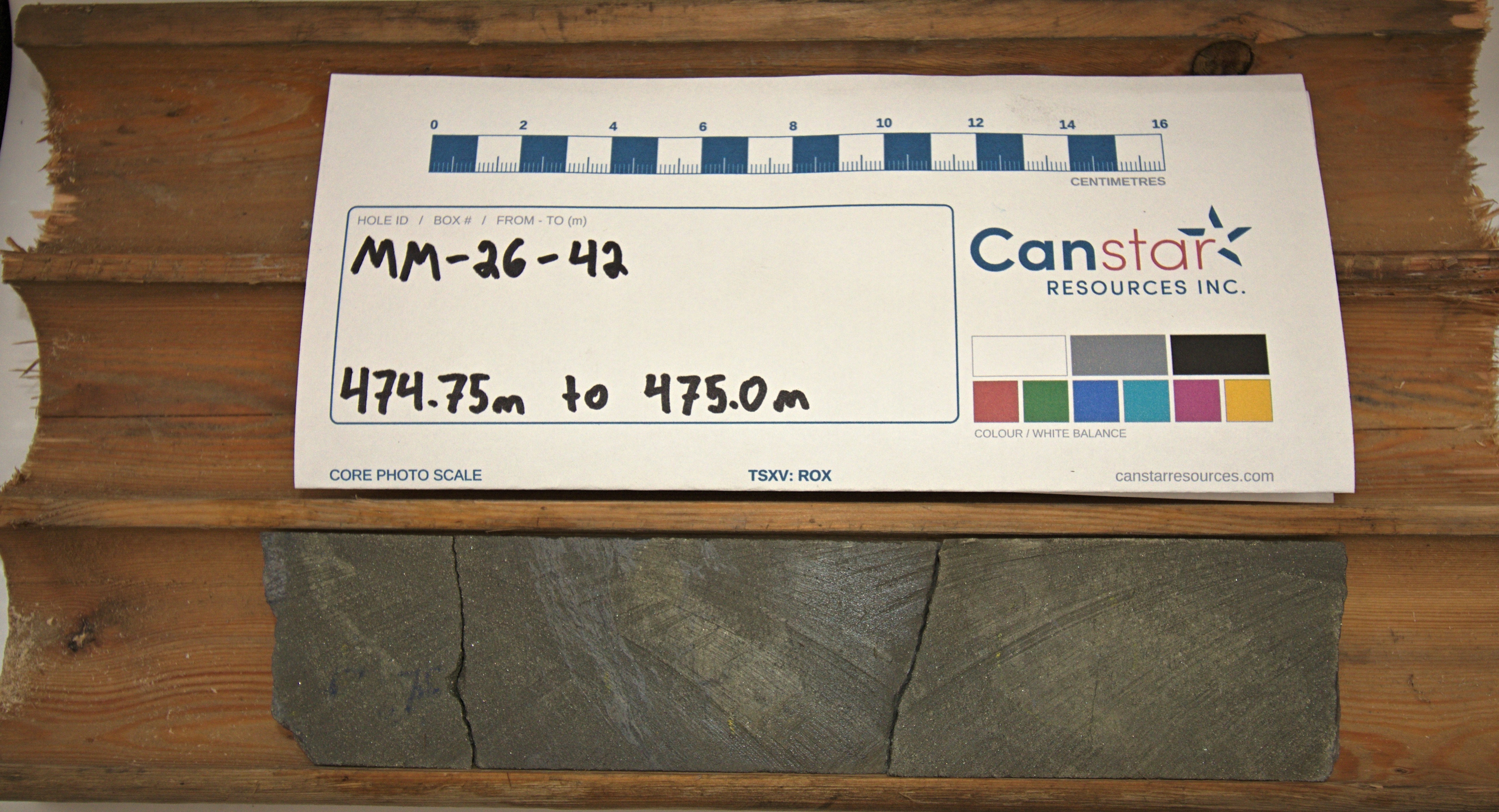
Photo 2 — Massive sulphide, sawn half core, 474.75 to 475.0 m, drill hole MM-26-42
Sawn half core, 474.75 to 475.0 m, drill hole MM-26-42, within the 474.0 to 475.0 m sample (0.98% copper, 4.40% zinc; 3.51% CuEq¹). Pale, resinous bands, identified during logging as sphalerite-rich, cut across pyrite-dominant massive sulphide carrying fine brassy sulphide grains; in this sample, zinc is the largest contributor to the CuEq grade. Selected detail; not representative of interval width or grade.
To view an enhanced version of this graphic, please visit:
https://images.newsfilecorp.com/files/1665/311773_b8624fd3d470e915_005full.jpg
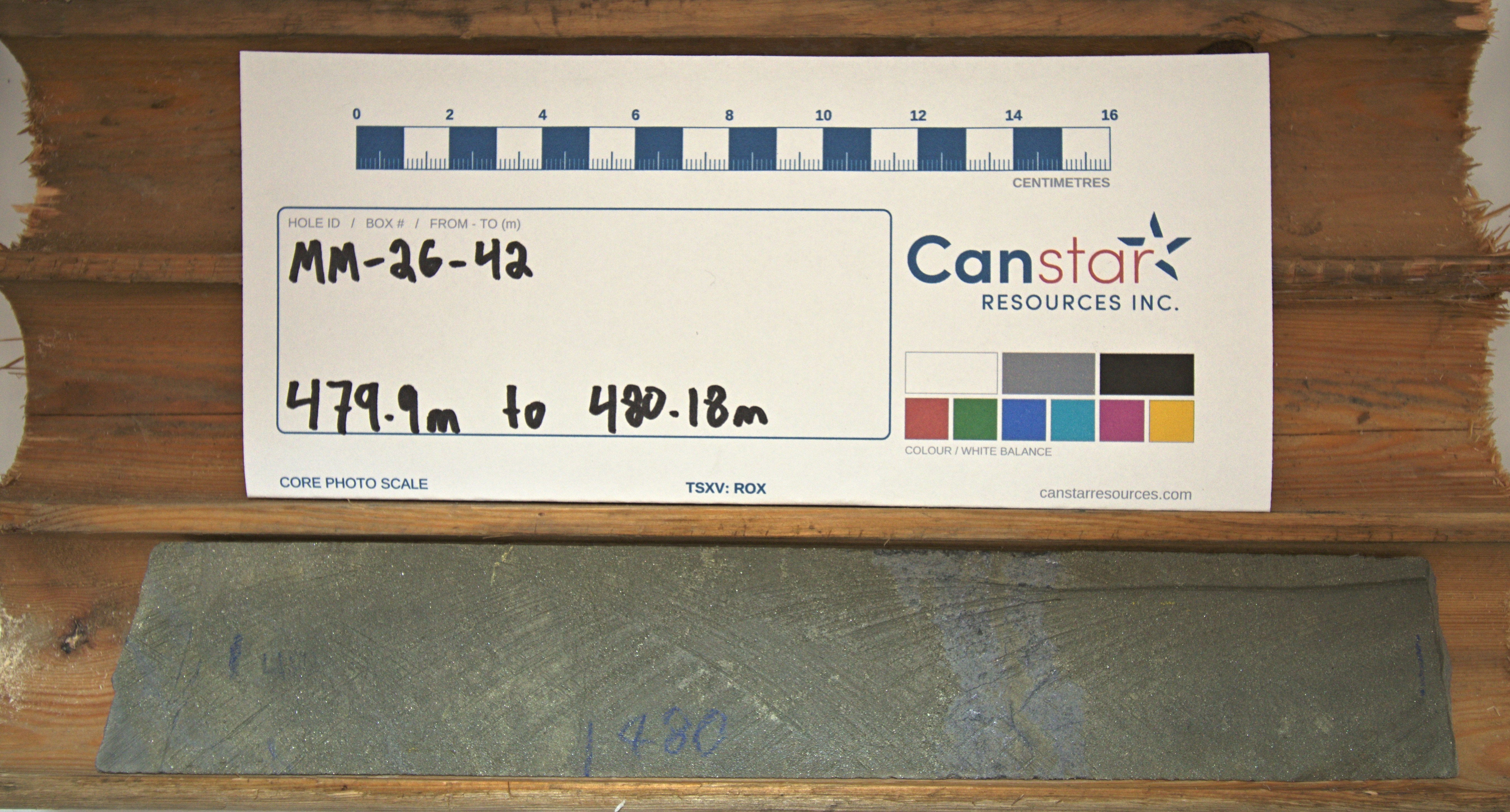
Photo 3 — Massive sulphide, sawn half core, 479.9 to 480.18 m, drill hole MM-26-42
Sawn half core, 479.9 to 480.18 m, drill hole MM-26-42, within the 479.0 to 481.0 m sample (1.05% copper, 3.13% zinc; 3.04% CuEq¹). Dense massive sulphide from edge to edge of the cut face: pyrite-dominant, with disseminated brassy sulphide grains and a contrasting pale band identified during logging as sphalerite-rich. Grade continues below the core box shown in Photo 1: this piece sits approximately 2.9 m deeper. Selected detail; not representative of interval width or grade.
To view an enhanced version of this graphic, please visit:
https://images.newsfilecorp.com/files/1665/311773_b8624fd3d470e915_006full.jpg
Photographs are selected details and are not representative of the grade, width, continuity or abundance of mineralization; assay results are pending for certain pictured intervals and no grade is reported or implied for them.¹, ²
About Canstar Resources Inc.
Canstar Resources Inc. (TSXV: ROX) is a focused VMS exploration company with a portfolio of projects in established mining jurisdictions. The Company's flagship Mary March VMS Project (approximately 148 km²) is located within the Buchans District in Central Newfoundland and is being advanced under an earn-in joint venture with VMS Mining Corporation. The Buchans mining camp is well-known for producing some of the highest-grade VMS deposits in North American mining history⁵. The Company's Skellefte VMS Project (approximately 68,000 hectares) is located in the northern portion of the Skellefte VMS belt of Sweden, a well-established VMS district. Canstar also holds the Golden Baie Project in southern Newfoundland, currently subject to an option agreement with Churchill Resources Inc.
For further information, please contact:
Juan Carlos Giron Jr., President & Chief Executive Officer
Email: info@canstarresources.com | Phone: (647) 557-3442 | www.canstarresources.com
Canstar acknowledges the financial support of the Junior Exploration Assistance ("JEA") Program from the Government of Newfoundland and Labrador Department of Industry, Energy and Technology. Neither TSX Venture Exchange nor its Regulation Services Provider (as that term is defined in the policies of the TSX Venture Exchange) accepts responsibility for the adequacy or accuracy of this release.
References
Copper-equivalent (CuEq) grades are calculated as CuEq% = Cu% + Zn% × (Zn price/Cu price) + Pb% × (Pb price/Cu price) + (Au g/t × Au price per gram)/(Cu value per 1% per tonne) + (Ag g/t × Ag price per gram)/(Cu value per 1% per tonne), using metal prices of US$6.37/lb copper, US$1.64/lb zinc, US$0.86/lb lead, US$4,040/oz gold and US$58/oz silver (spot basis, August 2026). Metallurgical recoveries have not been established for the Project; CuEq assumes 100% recovery for all metals and is provided for illustrative and comparative purposes only. Reported intervals are downhole lengths; true widths have not been determined.
Descriptions of mineralization for which assays are pending are based on visual core logging and are preliminary; visual observations are not a substitute for, and are not a proxy for, laboratory assay results, which may differ materially. No grade is reported or implied for pending intervals.
See the Company's news release dated July 8, 2026, available on the Company's website and under its profile on SEDAR+.
Historical results referred to in this news release (including the 1999 Mary March intercept and Nancy April intersections) are historical, predate, and were not prepared in accordance with, National Instrument 43-101. The Company's Qualified Person has not undertaken sufficient work to classify any historical result as a current mineral resource, and the Company is not treating any historical result as current. Historical results are not necessarily indicative of the mineralization the Company may delineate.
Buchans district production figures are third-party historical figures (1928-1984) provided for geological context; they have not been verified by the Company's Qualified Person and are not necessarily indicative of mineralization on the Company's mineral licenses. The Buchans deposits are described as "some of the highest grade VMS deposits anywhere in the world" in Piercey, S.J. (2007): Volcanogenic massive sulphide (VMS) deposits of the Newfoundland Appalachians: an overview of their setting, classification, grade-tonnage data and unresolved questions. Newfoundland and Labrador Geological Survey, Current Research Report 07-1, pages 169-178; and as "some of the highest-grade VMS deposits on the planet" in Piercey, S.J., Hinchey, J.G. and Sparkes, G.W. (2023): Volcanogenic massive sulfide (VMS) deposits of the Dunnage Zone of the Newfoundland Appalachians: setting, styles, key advances, and future research. Canadian Journal of Earth Sciences, 60(8): 1104-1142.
Sparkes, G.W. (2022): Short wavelength infrared spectrometry studies of sericitic alteration zones, southern Buchans-Roberts Arm belt, Newfoundland. Newfoundland and Labrador Geological Survey, Current Research Report 22-1, pages 85-118.
2019 trench and grab-sample results are drawn from the Company's government assessment filings. Grab samples are selective by nature and are not necessarily representative of mineralization on the property.
Forward-Looking Statements
This news release contains "forward-looking information" within the meaning of applicable Canadian securities laws, including statements regarding pending assay results and their timing; planned borehole electromagnetic surveys; the timing, funding and scope of the fall drill campaign; drill-rig availability; the completion of documentation relating to the Glencore royalty conversion; the interpretation of geological, structural and geophysical data; and the Company's exploration plans. Forward-looking information is based on assumptions management believes reasonable but is subject to known and unknown risks and uncertainties, including exploration results, financing, weather and access, contractor and rig availability, and regulatory approvals, that may cause actual results to differ materially. Readers are cautioned not to place undue reliance on forward-looking information. The Company undertakes no obligation to update forward-looking information except as required by law.

To view the source version of this press release, please visit https://www.newsfilecorp.com/release/311773
Copyright 2026 ACN Newswire. All rights reserved. www.acnnewswire.com
Tokyo Overnight
Japan markets, decoded. Get the brief in your inbox.
No spam. Unsubscribe anytime.